Module 1 · Lesson 2
Why markets can predict
A prediction market price is a probability — and, remarkably, it can forecast the future more accurately than the experts, because it aggregates what many independent people privately know into a single number. This lesson builds that mechanism, tests it against the evidence, and finds its limits.
- Explain how a market price pools information no single person holds
- Identify the conditions a crowd needs to forecast well — independence, diversity, and skin in the game
- Weigh the factors that make a market's price more or less reliable — how many are trading, whether they have real information, and how near the price sits to an extreme
- Judge how much to trust a given price instead of treating it as always right or always wrong
The idea is older than the technology
Here’s a claim that sounds too good to be true: a crowd of strangers, trading for their own profit, can forecast the future more accurately than the experts whose job it is to forecast it. It’s the whole reason prediction markets matter — so this lesson has to earn it, not just assert it. And the best place to start is that the idea isn’t new. It’s one of the oldest in economics, and the history is the argument.
In 1945, Friedrich Hayek published an essay called The Use of Knowledge in Society, asking: how does an economy coordinate when the knowledge it needs is scattered across millions of people, none of whom sees the whole picture? His answer: prices do the gathering. When tin gets scarce its price rises, and everyone who uses tin adjusts — without needing to know why. The price carries the information, compressing what thousands privately know into one readable number. A prediction market is that insight turned into a purpose-built tool: a contract whose only job is to have a price that means “the probability of this event.”
In 1988, economists at the University of Iowa tested it for real — the Iowa Electronic Markets, real money, tiny stakes, trading the US presidential election. The question: could a few hundred people beat the polls? They could. Across 1988 and many elections since, the market has landed closer to the result than the major polls — not just on election day, but months out.
Why? A poll asks “who will you vote for?” — a question about you. A market asks “who will win?” — a question about the world. Betting money, you don’t answer with your preference; you answer with your best read of everyone’s behavior, including what polls miss. The better question gets the better answer.
The condition that makes it work
Why does a crowd beat the experts? One ingredient hides inside every case — independence. When people estimate separately, their errors point in different directions. Average many independent estimates and the errors cancel — one person’s too-high offsets another’s too-low — leaving the signal they shared: the truth, or close to it.
Independence is the engine behind “the wisdom of crowds” — the part that actually makes it run. (Surowiecki popularized the phrase in his 2004 book of the same name.) The classic example isn’t even a market: at a 1906 county fair, Francis Galton watched 787 people guess an ox’s weight. No single guess was exact — but the average was 1,197 pounds, and the ox weighed 1,198. The crowd was off by one pound, beating every individual in it. It worked because the guesses were independent: nobody conferred, so the scattered errors canceled.
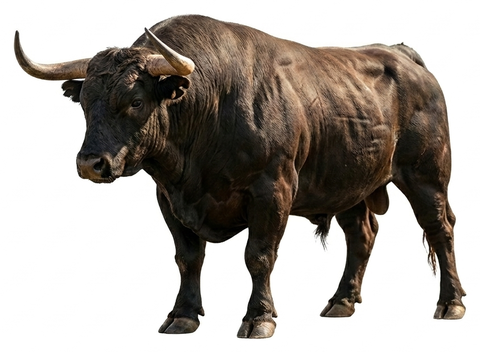
How much does this ox weigh?
Hold onto that word — independent — because it’s also where everything falls apart.
When the crowd stops thinking
If independence is the engine, anything that destroys it breaks the machine — and the biggest culprit is built into every real market: everyone can see the price.
Galton’s fair worked because no one saw anyone else’s guess. Real markets are visible. When traders stop forming their own estimate and start copying the price (“it’s at 70%, so it must be likely”), the errors stop canceling and start compounding. The crowd stops thinking and starts following — that’s how bubbles form, and prediction markets aren’t immune. Watch the same 787 people when they can see each other:
Now let the crowd see itself
Same 787 people, same ox. The only thing that changes is whether each person can see the guesses made before theirs.
Independence is fragile: the very act of publishing a price can quietly dismantle the thing that made it smart.
Factors affecting market reliability
How accurately a price reflects reality depends on the market behind it. We call this market reliability. It’s strengthened by deep participation and genuine information, and weakened by thin trading, manipulation, and systematic biases. Below are the most common conditions and forces that affect it.
- Deep market — a market works best when it’s deep: many independent traders, real money, and enough activity that any bad price gets corrected fast. This is the condition the whole lesson has assumed — the crowd is large, diverse, and thinking for itself. The three failures below are all departures from it.
- Thin markets — the wisdom of crowds needs a crowd. Five traders aren’t aggregating diverse information — they’re five people who might all be wrong the same way. On obscure questions with little money, prices are noisy and easily pushed around. The magic scales with participation; a market nobody trades tells you almost nothing.
- Manipulation — because a price is a public signal, someone with an agenda has a reason to distort it — buying a candidate’s contract to fake momentum and move the number headlines quote. In deep markets that’s expensive: other traders pounce on the mispricing. In thin ones, a single motivated actor can move it. The defense is the same as against noise — volume and liquidity.
- Favorite-longshot bias — the market misprices the extremes. Long shots trade slightly too high — people overpay for the thrill, like lottery tickets — while favorites trade slightly too low. The market stays directionally right, but the probabilities are skewed at the extremes.
None of these break the core claim — they bound it. A market forecasts well when it has enough independent participants, real incentives, and enough liquidity to punish distortion. Take those away and it degrades: gracefully at first, then completely.
So how much should you trust a price?
A price is not the truth. It’s the best available estimate — and it works better under some conditions than others. So the useful question isn’t “is this right?” but:
- How many people are trading this? Thousands of participants deserve more trust than a handful.
- Do they have real information, or is everyone guessing? A market on corporate earnings aggregates insight; a market on a random event aggregates noise.
- Is the price near an extreme? At 50% the market is usually sharp. At 2% or 98%, treat the exact number with skepticism — long-shot bias lives at the edges.
- Does anyone have a reason to distort it? A high-profile political market headlines will quote is a bigger target than a quiet sports one.
Ask those, and a price becomes what it actually is: not an oracle, but the sharpest forecasting tool we have for the questions it handles well.
Putting it together: a price is a machine
Now make it concrete. Say that in tonight’s match, USA vs. Spain — Winner, the “USA wins” contract is trading at 65¢. That number isn’t a guess about how you feel; it’s the crowd’s probability, assembled from what everyone trading privately knows.
Picture two of those traders. One watched every USA game and thinks it’s 70% — she buys, nudging the price up. A former team physio knows the USA’s best defender is quietly hurt and thinks it’s 55% — he sells, nudging it down. Neither knows what the other knows, but the price absorbs both at once.
A price is a weighted average of what everyone trading privately knows — each person’s pull sized by how much money they’ll risk.
Everything in this lesson lives in the machine below. Each dot is a trader — its height is their estimate that USA wins, its size is how much they bet. The line is the crowd average: the market’s price, and the single number the market reports. It’s not a plain average, though — each trader’s pull is weighted by how much they bet, so a big-bet trader moves it more than a small one. Drag a dot to feel it, then run the failure modes you just met and watch the average distort:
The market is a machine — drag a trader, then break it
The price is a machine, not an oracle
A price can predict because it aggregates scattered private information, weighted by conviction, into one number — Hayek’s 1945 insight, proved by the Iowa markets in 1988 and demonstrated by Galton’s ox decades before. The engine is the independence of the people trading: their errors cancel, and the signal survives.
The engine stalls when independence breaks — that’s herding. And even when the engine runs, the estimate is only as good as the factors affecting market reliability such as a deep market, thin markets, manipulation, and favorite-longshot bias. The price isn’t the truth; it’s the best estimate the whole market can produce — a machine that turns many guesses into one price.
Next, we get concrete about the machinery itself — how contracts are actually bought, sold, and held: order books, liquidity, and the gap between the price you see and the price you get →
Related lessons
Previous in Module 1:
- Lesson 1: What is a prediction market? — What you trade, how the price works as probability, and what happens when an event resolves.
Next in Module 1:
- Lesson 3: The order book, order entry & the tape — The mechanics of buying, selling, and holding contracts. Order books, liquidity, and the friction between the price you see and the price you get.